Reading a Bakery-Café Menu: Breads, Viennoiserie and What the Terms Mean
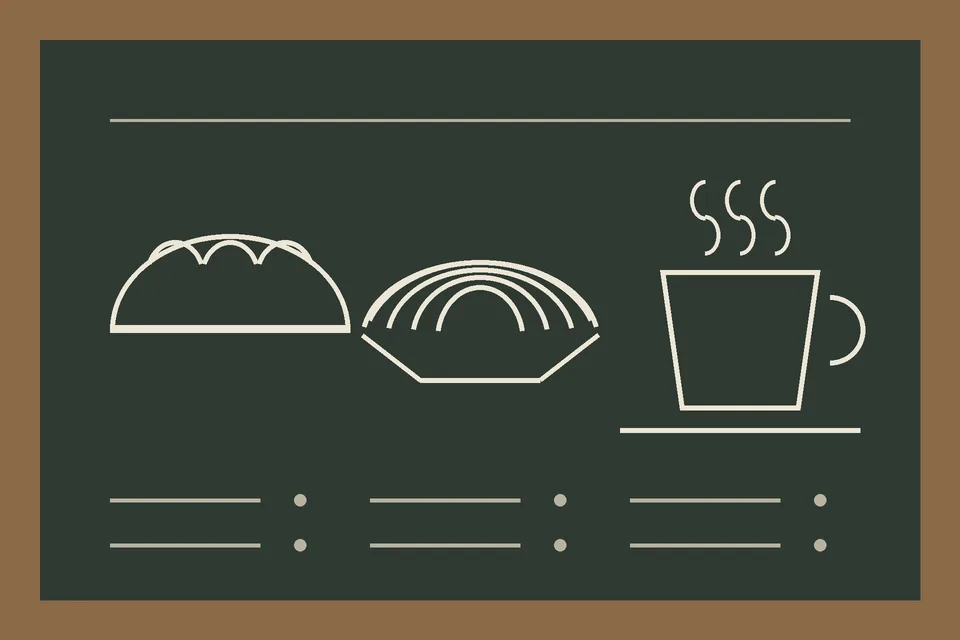
A bakery-café menu board packs a lot of vocabulary into a few lines of chalk: levain, country loaf, seeded rye, viennoiserie, kouign-amann, tartine. Some of these words have a legal definition, some describe a technique, and some are just a baker's way of naming a loaf. This guide sorts them out, so you know what you are ordering and which questions are worth asking at the counter.
The bread column
Most boards list breads by a mix of three things: how the dough was raised, what flour went into it, and what shape it was baked in.
Leavening: levain, sourdough and yeast
Levain and sourdough both mean a bread raised by a culture of wild yeasts and lactic acid bacteria rather than, or as well as, commercial baker's yeast. We explain the difference between a starter and a levain, and what the microbes do, in What is levain? A naturally leavened loaf typically has a thicker crust, a more open and slightly chewy crumb, and a mild to pronounced tang, and it keeps longer than a yeasted loaf of the same size.
In the United States there is no federal definition of "sourdough", so a loaf sold under that name may be raised partly with commercial yeast and flavoured with added acids. If it matters to you, ask whether the bread is made with a starter only. France is stricter: its 1993 bread decree (décret n° 93-1074 of 13 September 1993) reserves the name pain au levain for bread raised with a natural leaven, sets a maximum acidity (pH 4.3) and a minimum level of acetic acid, and allows only a very small dose of baker's yeast at the final mixing.
Poolish and biga, which appear on some boards, are pre-ferments made with commercial yeast: a portion of flour, water and a little yeast left to ferment for several hours before the main dough. They add flavour without the sourness of levain.
Flour: white, whole wheat, rye and "multigrain"
- Whole wheat. In the US this is a legal term. The federal standard of identity for whole wheat bread, rolls and buns (21 CFR 136.180) requires the dough to be made from whole wheat flour, with no white flour. "Wheat bread" with no "whole" is not the same thing and is often mostly white flour.
- Multigrain, seeded, "artisan". These have no federal standard. Multigrain means more than one grain, not whole grain; the ingredient list, if you can see it, is the only reliable guide.
- Rye. A "rye" can range from a mostly wheat loaf with a little rye flour to a dense, dark loaf that is mostly rye and usually made with a sour culture, because rye dough needs acidity to set properly. Our rye levain loaf recipe shows why.
- Local or heritage flour. Some bakeries name the mill or the wheat variety. In Minnesota that often means flour from small regional mills; see Minnesota flour and the mills behind it.
Shape: boule, bâtard, baguette, pan loaf
A boule is a round loaf and a bâtard an oval one; both are typical shapes for a country levain loaf. A baguette is long and thin, so it is mostly crust and goes stale within a day. A pan loaf or sandwich loaf is baked in a tin, which gives a soft side crust and even slices. Shape changes the eating more than people expect: the same dough baked as a baguette and as a large boule tastes and keeps very differently.
The French decree also defines pain de tradition française, which can be made only from wheat flour, water, salt and yeast or levain (with a few tiny listed additions), contains no additives and must never have been frozen. You will occasionally see the phrase on boards in North America too, but it has no legal meaning outside France.
The pastry case: viennoiserie and pâtisserie
French bakers divide sweet baked goods into two families. Pâtisserie covers tarts, cakes, éclairs and other pastries built from pastry doughs, creams and fillings. Viennoiserie, literally "things in the Viennese manner", covers yeast-raised doughs enriched with butter, sugar, milk or eggs. Viennoiserie itself splits in two:
| Type | How it is made | On the board |
|---|---|---|
| Laminated | A yeasted dough is folded around a slab of butter and rolled out repeatedly, creating many thin layers that puff and separate in the oven | Croissant, pain au chocolat (chocolatine in south-west France), pain aux raisins, almond croissant, kouign-amann |
| Enriched, not laminated | Butter, eggs and sugar are mixed into the dough itself, giving a soft, cake-like crumb | Brioche, brioche à tête, many morning buns and cinnamon rolls |
Two terms are worth knowing. Croissant au beurre means an all-butter croissant; in France it is distinguished from the croissant ordinaire, which may be made with other fats. Twice-baked or almond croissants are usually made from the previous day's croissants, split, filled with almond cream and baked again; that is traditional, not a shortcut to hide. Kouign-amann, from Brittany, is a laminated dough with sugar folded in with the butter, so it caramelises in the oven.
The savoury side
- Tartine. An open-faced slice of bread, often levain, with a topping. On a café menu it is usually toasted and can be a full meal.
- Croque monsieur / croque madame. A toasted ham and cheese sandwich, often with béchamel; the madame adds a fried egg on top.
- Quiche. A savoury custard of eggs and cream baked in a pastry shell. Quiche lorraine is the bacon version.
- Galette. Two different things: in Brittany, a savoury buckwheat crêpe; elsewhere, a free-form rustic tart. In January, a galette des rois is a puff-pastry cake filled with almond cream.
- Soup of the day. In Minneapolis, often a version of the state's own wild rice soup.
Allergens, calories and what the law requires
Packaged foods in the US must declare the major food allergens on the label. The FDA's page on food allergies lists nine: milk, eggs, fish, crustacean shellfish, tree nuts, peanuts, wheat, soybeans and sesame, the last added as of 1 January 2023. Those labelling rules do not apply to food served unpackaged over a café counter, so the board is unlikely to tell you. Bakeries also share surfaces, mixers and ovens, and nut-based pastries such as almond croissants are made alongside everything else. If you have an allergy, tell staff what it is and how severe, and ask about cross-contact rather than only ingredients.
Calories appear on the board only at larger chains: the FDA's menu labeling requirements apply to restaurants and similar food establishments that are part of a chain with 20 or more locations. An independent neighbourhood bakery does not have to post them.
Sourdough is also not a gluten-free option. Fermentation does not remove gluten to a safe level, as we explain in our levain guide.
Questions worth asking at the counter
- Is the sourdough made with a starter only, or with added yeast?
- Is the whole wheat loaf 100% whole wheat flour?
- What came out of the oven most recently?
- Are the croissants all-butter, and are they baked here?
- Which items contain nuts or sesame, and are they made on shared equipment?
Sources
- US Code of Federal Regulations, 21 CFR Part 136, Bakery products, including section 136.180 on whole wheat bread.
- US Food and Drug Administration, Food allergies.
- US Food and Drug Administration, Menu labeling requirements.
- République française, décret n° 93-1074 du 13 septembre 1993 pris pour l'application de la loi du 1er août 1905 en ce qui concerne certaines catégories de pains (Journal officiel, published on Légifrance).
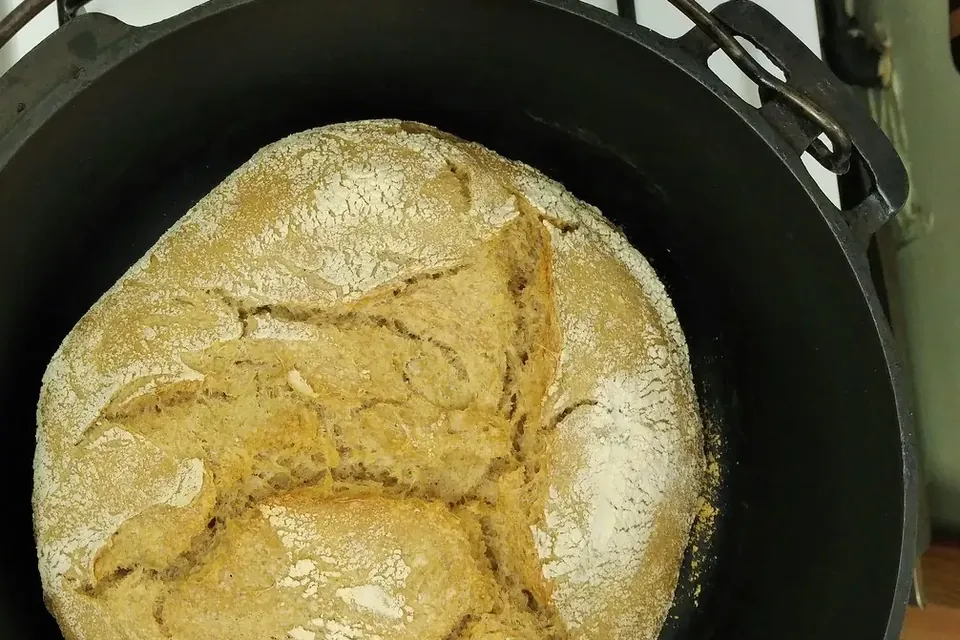 Bread & levain
What is levain?
Starter, levain, sourdough: what the words mean, what the microbes do and why the bread tastes the way it does.
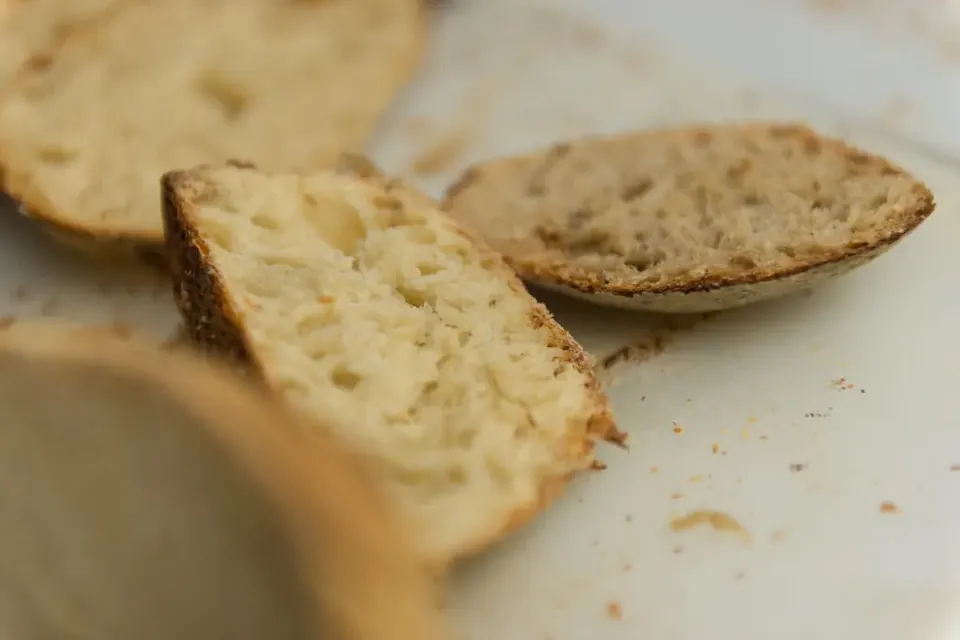 Recipes
Country levain loaf
Bread flour, a little whole wheat, water, salt and levain: a two-day timetable and every step explained.
 Bread & levain
Minnesota wheat and flour
Spring wheat, protein percentages, whole grain and Kernza: how to read a bag of flour before you bake.