Wild Rice (Manoomin): Minnesota's State Grain, From Lake to Kitchen
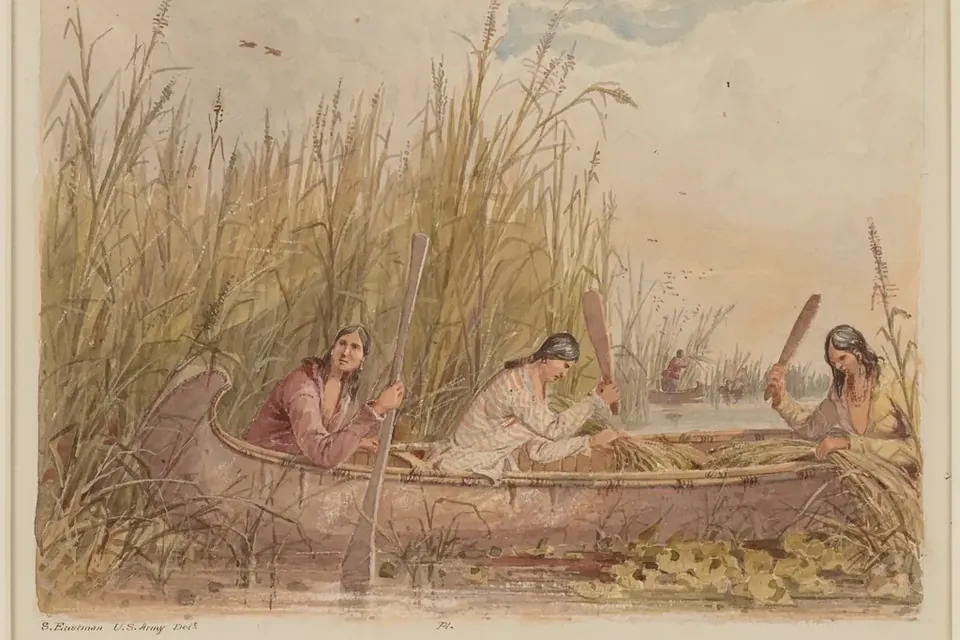
Few foods are as closely tied to Minnesota as wild rice. It grows in the shallow lakes and slow rivers of the north, it has been harvested by Ojibwe and Dakota people for centuries, and it is the state's official grain. It is also not rice at all, but the seed of a native aquatic grass, and the way it reaches your kitchen is unlike any other grain.
A grass that grows in water
Wild rice is an annual grass that germinates each spring from seeds lying in the soft bottom of lakes and rivers. It grows best in clear, slowly moving water roughly 0.5 to 1 metre deep. Through early summer it floats on the surface in a "floating leaf" stage, then stands upright, and by late summer it carries seed heads well above the water. The grains ripen unevenly over several weeks, and ripe grains fall easily, which is both why harvesting is done gently over many days and how the stand reseeds itself.
Because it depends on stable water levels and good water quality, wild rice is sensitive to floods, drought, dams, boat wakes and pollution. The Minnesota Department of Natural Resources monitors natural stands, and the Minnesota Pollution Control Agency has long debated how to protect wild rice waters from sulfate pollution, which can harm the plant.
Manoomin: a sacred food
For the Anishinaabe (Ojibwe) people, manoomin, "the good berry", is central to culture and history. Ojibwe oral tradition describes a westward migration that ended in the place "where food grows on the water". The Dakota, who lived in the region before and alongside the Ojibwe, also harvested wild rice, which they call psiŋ. The harvest, called ricing, is a seasonal gathering of families and communities, and the rice is a staple, a ceremonial food and a source of income.
Treaties signed in the nineteenth century reserved the right of Ojibwe bands to hunt, fish and gather, including ricing, on ceded lands. On several reservations, including White Earth, Leech Lake, Bois Forte, Grand Portage, Fond du Lac and Mille Lacs, wild rice committees set harvest dates and rules, and the DNR's regulations defer to them. Since 2016, members of federally recognised tribes in Minnesota with a valid tribal identification card are deemed to hold a state wild rice licence. The Minnesota Historical Society and tribal nations' own cultural departments are good places to learn more.
How the harvest works
Ricing by hand is done from a canoe. One person stands in the stern and pushes the canoe slowly through the stand with a long forked pole; the other sits in front and, with two light wooden sticks called flails or knockers, bends the stalks over the canoe and taps the ripe grains loose. Unripe grains stay on the plant for a later pass. The rules for the public harvest, published by the DNR, are strict:
| Rule | Requirement |
|---|---|
| Season | 15 August to 30 September, 9 a.m. to 3 p.m. daily; harvesting unripe ("green") rice is illegal |
| Licence | Residents: season or one-day licence; non-residents: one-day licence; residents under 18 exempt when with a licensed harvester |
| Watercraft | No longer than 18 feet and no wider than 36 inches; no extensions that increase capacity |
| Push pole | Forked at the end, forks under 12 inches |
| Flails | Round, smooth wood, no longer than 30 inches and no heavier than one pound, operated by hand |
| Machines | Prohibited on public waters, with narrow exceptions |
National parks and national wildlife refuges are closed to harvest except by special permit, and reservation waters follow tribal rules. Anyone thinking of trying ricing should read the DNR page in full, learn from experienced harvesters and check local announcements on ripeness.
From green rice to finished grain
Freshly harvested "green" rice is wet and perishable and must be processed quickly. Traditional processing has four steps: drying the rice in the sun; parching it in a large kettle over a wood fire, stirring constantly, which loosens the hull and gives the characteristic toasted flavour; hulling, traditionally by "dancing" or "jigging" on the parched rice in a lined pit to rub off the hulls; and winnowing, tossing the rice in a birchbark tray so the wind carries away the chaff. Many harvesters now take their green rice to small licensed processors who use mechanical parchers and hullers.
Natural versus cultivated
From the mid-twentieth century, growers in Minnesota and later California developed paddy cultivation of wild rice, with varieties that hold their seeds longer so they can be combine-harvested. Most of the wild rice in supermarkets is cultivated. Minnesota law requires cultivated rice to be labelled "paddy" or "cultivated", while 100% natural rice may be labelled "100 percent naturally grown, lake and river wild rice" (Minn. Stat. § 30.49). Many Ojibwe people object to the marketing of paddy rice as "wild" and to genetic research on the plant, seeing natural manoomin as a gift that should not be altered.
| Hand-harvested (natural) | Cultivated (paddy) | |
|---|---|---|
| Look | Varied browns and greens, often shorter, matte grains | Uniform, long, glossy, almost black grains |
| Cooking time | About 20–30 minutes | About 45–60 minutes |
| Flavour | Toasty, nutty, tea-like from fire parching | Earthier, firmer, chewier |
| Where to buy | Farmers markets, co-ops, tribal and harvester businesses | Supermarkets, bulk bins |
Cooking and eating wild rice
Rinse the rice, then simmer it in about three to four times its volume of salted water until most grains have split and are tender, and drain any extra liquid. Follow the package for timing, since natural rice cooks much faster. Cooked wild rice goes into soups (see our Minnesota wild rice soup), hot dishes, stuffings, salads with dried cranberries and toasted nuts, pancakes and breads. It freezes well.
Where to see or buy it
- Look for hand-harvested rice at Twin Cities farmers markets in late summer and autumn (see our market guide).
- Buying directly from tribal nations' enterprises and Native-owned businesses supports the people who have stewarded the harvest for generations.
- Read labels carefully: "wild rice" alone does not tell you how it was grown.
Sources
- Minnesota DNR: Wild rice regulations; Wild rice management.
- Minnesota Statutes: section 30.49, wild rice labeling.
- Minnesota Pollution Control Agency: wild rice and sulfate.
- Minnesota Historical Society.
 Recipes
Minnesota wild rice soup
Wild rice, vegetables, stock and a little cream: the state's comfort soup, with a vegetarian option and cooking times.
 Markets & seasons
Seasonal produce calendar
Rhubarb in May, strawberries in June, sweet corn in August, apples in autumn: a month-by-month guide to the Minnesota harvest.
 Markets & seasons
Twin Cities farmers markets, 2026
The big markets and the neighbourhood ones, with their published 2026 days, hours, addresses and winter schedules.